
Why Integer Rules Don’t Work And What to Do Instead
Frustrated that your middle schooler is still mixing up the rules (or inventing new ones!) when they add, subtract, multiply or divide with integers? Learn why the ‘rules’ don’t stick–and how to teach integer operations in ways that make sense instead.
I’ve recently started a new school year with a sweet group of 7th graders and I bet you can guess the very first topic of the year…yup, integers and integer operations! I LOVE teaching integer operations, because I love to help kids see, explore, and discover on their own and then watch the ‘lightbulb’ moments when things start to click. I also love learning *new ways* to help them make sense of these concepts because it really is one of the more foundational topics they will cover as they prepare for Algebra and beyond.
*Please Note: Some of the links in this post are affiliate links which help support the work of this site. Read our full disclosure policy here.*
Unfortunately, many times I see this taught in middle school classrooms (like so many other topics) as a list of rules to memorize. What does this list look like? You might see (or be familiar with) some of the following (Side note: I found these by googling ‘rules for adding & subtracting integers’ because I could not even tell you what the ‘rules’ are off the top of my head. And I have a degree in math. 🙄).
Common Integer Operations Rules:
- Adding Same Signs: Add the numbers together and keep the same sign. (Ok, I guess this might be helpful, but it doesn’t really explain why…plus, it’s something they have to memorize)
- Adding Different Signs: Subtract the smaller absolute value from the larger absolute value, and use the sign of the number with the larger absolute value. (Seriously?…what 12 or 13 year old is able to interpret AND remember this???)
- To subtract integers, use the Keep-Change-Change rule (also known as adding the opposite) (Again…this does not explain WHY…AND students have to remember what ‘keep, change, change’ means…)
Some Problems with Integer Operations Rules:
As you’re probably aware by now, I am not a fan of teaching these rules. Here are some problems that I see as a result of trying to memorize these math rules:
-
To a student being introduced to operations with integers for the first time, these rules are nonsensical (or some kind of weird, math magic).
If you’re not sure you agree with my assessment here, go back and read the rules aloud to yourself. Then imagine you’re a kid hearing each rule for the first time. Do you understand what each rule means?
Consider the second rule for ‘adding integers.’ First, the rule starts by subtracting…wait, I thought we were adding? Then it says ‘subtract the smaller absolute value from the larger absolute value.’ Even if you have taught absolute value…do students have a deep enough understanding of absolute value and its real world applications to understand what this is saying and why it works? Lastly, the rule says ‘use the sign of the number with the larger absolute value.’ WHAT? Again, to a student with very little exposure in their life thus far to integers and absolute value, this seems like an arbitrary or magical conclusion. Is the answer positive or negative? Well, just use the sign of the larger absolute value. How exactly is this helpful?
-
The rules get jumbled in their minds or weirdly mixed with other rules and get applied incorrectly (because they don’t actually understand what they’re doing or why).
When these become another addition to a long list of ‘math rules’ to know, students begin to mix them together, use a rule in the wrong context, combine rules together, or just create their own rules out of thin air (because they know there’s some rule, but what was it? Maybe something like this…and then they make things up).
-
Memorizing rules requires follow-up with endless drill and practice (so they can make sure to recall the memorized rules and practice using them until they know them by heart).
If you are teaching students to learn these rules and use them correctly, you are going to have to give them endless amounts of practice. This means taking more class time and homework time to drill and drill and drill until they have learned the rules and can use them. If, however, you provide them the tools they need to understand, visualize, and apply the operations in ways that make sense, they don’t need to drill practice 100 different problems. They can use their tools to figure out each problem as it comes up.
-
If the rules are not understood AND memorized, students will inevitably fail the quiz and test. And many students lack the motivation needed to actually memorize and practice enough for the rules to stick long term.
To actually learn what these rules mean and then use them correctly will take time and dedication. Let’s be honest…for a lot of students, the motivation needed to put in that time and effort just isn’t there. Which means they will not be successful.
-
Memorizing and applying these rules make integer operations so much harder than they need to be.
Lastly, and probably most importantly in my mind, when integer operations are taught as rules to memorize, we’re making the task SO MUCH HARDER than it needs to be!
Helping students build upon their understanding and prior knowledge of addition and subtraction with positive numbers (so they don’t feel like they’re learning something brand new and unrelated to the rest of math) and then use tools (like number lines and +/- charts) to figure out the answer is easier than spending days and weeks trying to memorize these rules and practice over and over again.
It will mean less time on this unit, more success for your students (building their confidence!), and math that actually sticks so students can still add -3 + 7 come May.
How to Teach Integer Operations So It Sticks
So I’ve now rambled on for 1,000+ words about all the issues I have with teaching integer rules. If you’re still with me, you’re probably ready for some tips and ideas for a better solution!
Here are my tips for teaching integer operations so that it sticks:
1. Begin by reminding students of what the operations mean and remind of this often as they practice solving problems.
Start very simply with addition & subtraction on a number line. Talk about whether the value will increase or decrease. Talk about subtraction as the difference between the two, or the distance apart on the number line. Then apply that same understanding to integers. Begin multiplication by exploring what is meant by 3 x 4. Equal groups, repeated addition, arrays, etc. Then have students consider what 3 x -4 would look like visually to help make the connection that a positive times a negative will result in a negative product.
2. Use multiple strategies and representations.
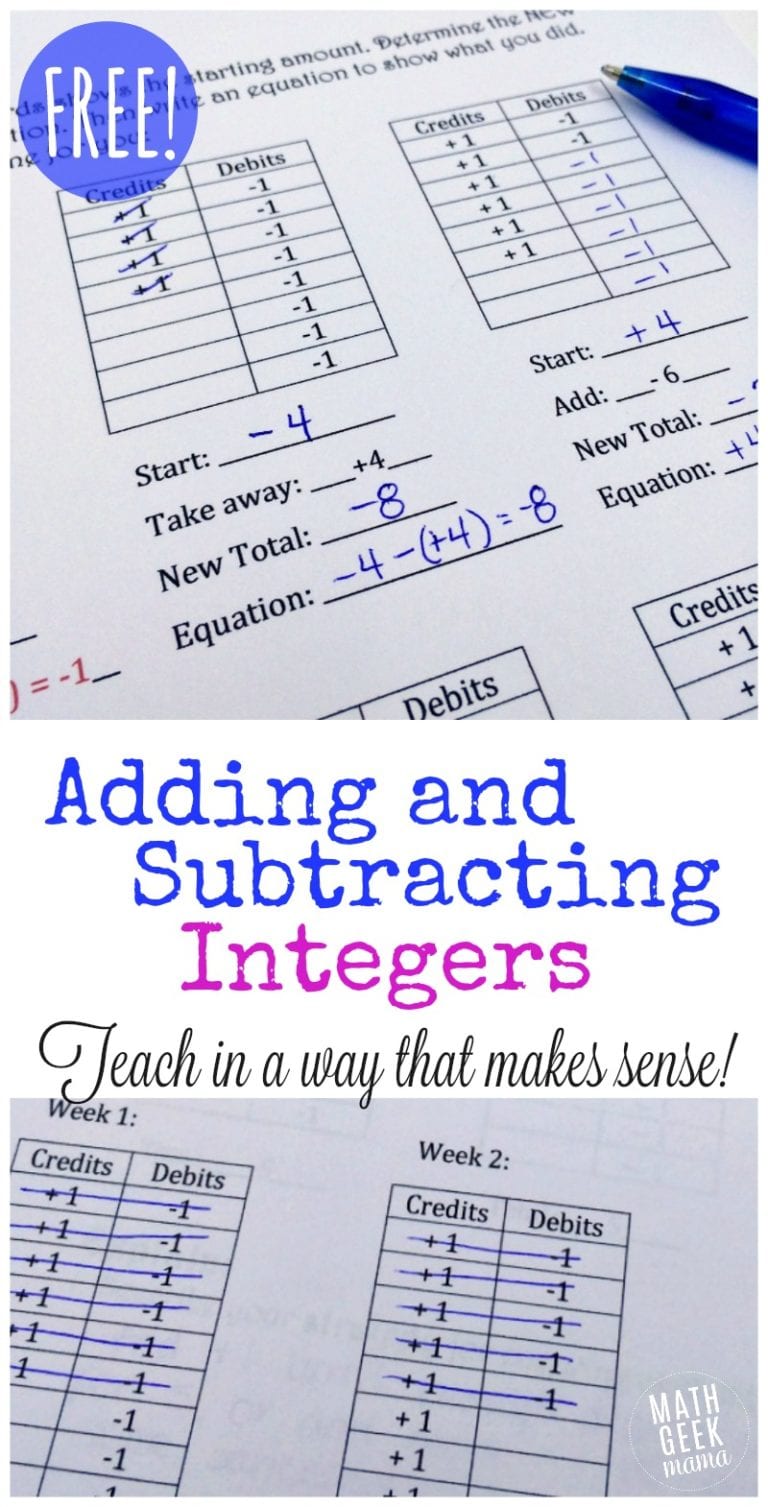
When I begin to explore integer operations with my students, we use number lines, real life situations (budgeting or temperature are good examples) and +/- charts. A +/- chart is especially helpful in showing why subtracting a negative value is the same as adding. We then explore a single integer expression with multiple representations.
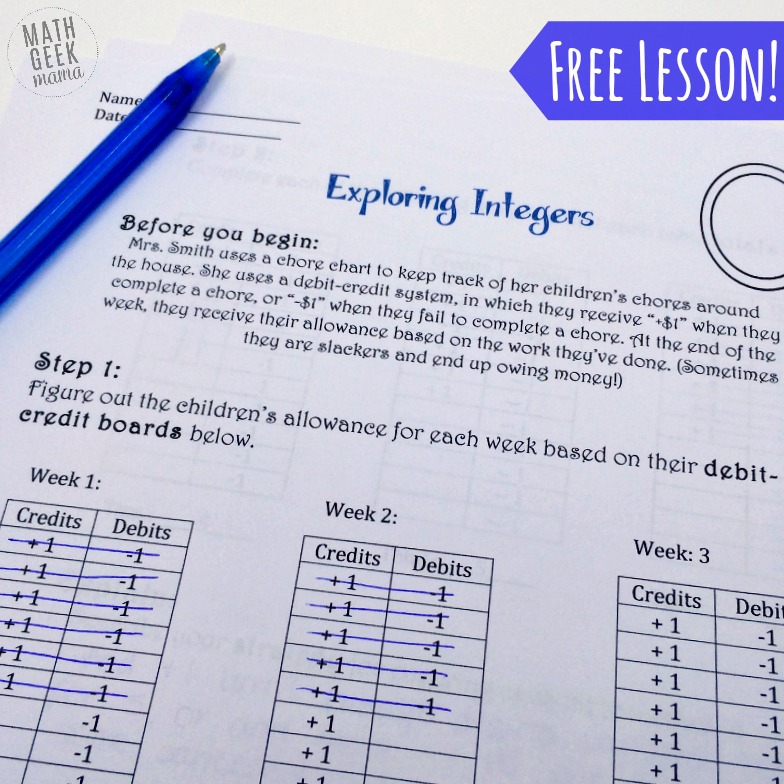
I also use two-colored chips to explore with integers and teach multiplication & division of integers in a way that makes sense. See an intro lesson here.
3. Explore integers in real world contexts (start here, don’t end here!).
Students can often correctly solve a real life problem involving integers more easily than a ‘bare number’ problem because they solve it intuitively rather than trying to remember a rule.
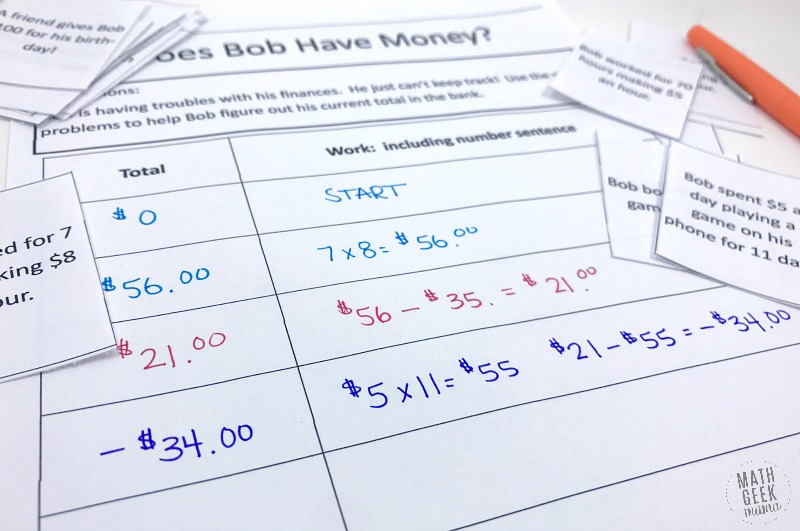
Again, I begin our introduction to integers using real life examples such as temperature and money. This is especially help when considering subtracting a negative. If you subtract (remove/take away) a debt (a negative), your value will increase. Try out this budgeting lesson to provide real life practice with adding and subtracting integers.
4. Circle back to integers often.
Use your first ten minutes as a quick warm-up to look at a real life problem in depth, represent an integer expression multiple ways, or play a quick review game.
Find simple lessons, games, and additional resources for teaching and exploring integer operations at the links below.
Looking for Resources to Teach Integer Operations? Try Some of the FREE Lessons and Games Below!
-
-
-
-
- Add & Subtract Integers Lesson with +/- Charts
- Real Life Add & Subtract Integers Lesson with Budgeting
- Intro to Multiplying & Dividing Integers Lesson
- Multiply & Divide Integers Sorting Challenge
- Gingerbread Dash: Printable Board Game to Practice Integer Operations
- Easter Peeps: Integer Operations Matching Game
- Exploring Integers: Bundle of Resources to Teach & Practice Addition/Subtraction with Integers
-
-
-